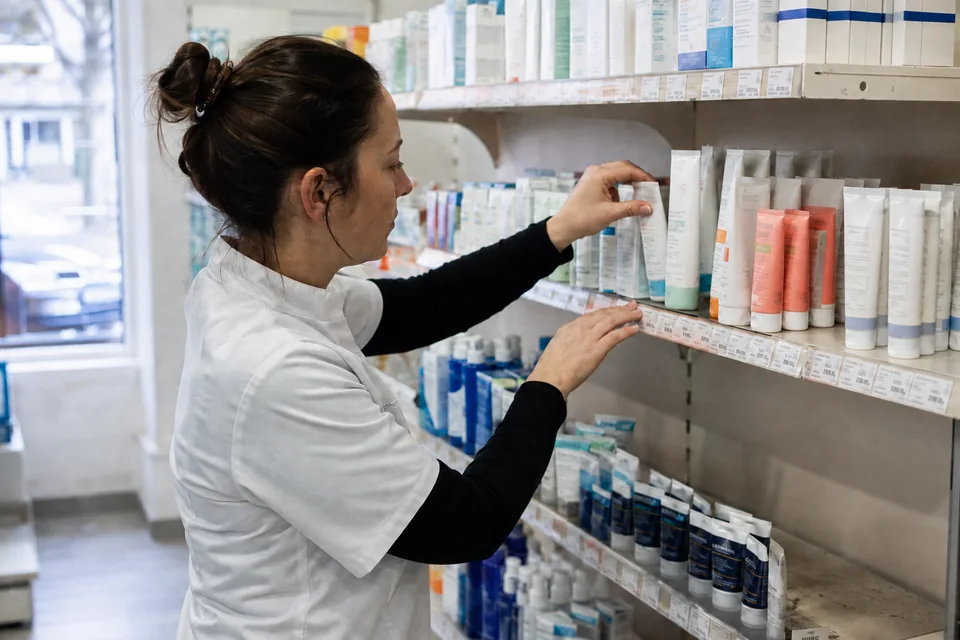
The display unit has been delivered, but it is still in the stockroom. Two lines are selling, the third takes up space without moving. For a brand, pharmacy merchandising starts with situations as concrete as these: understanding the space available, agreeing a useful shelf placement and checking what it produces.
Work with the pharmacy’s constraints
The pharmacist has to organise a limited space, keep the aisles clear and meet the needs of their patients. The brand wants its range to be visible. A credible proposal takes both into account: dimensions, number of lines, stock required, season and the time asked of the team.
Ask for permission before moving a product, installing a POS display or photographing a shelf. Merchandising does not give the brand free access to the shelves. The examples in this guide mainly concern skincare and health and beauty products; medicines and other regulated products require the approvals specific to their category.
Measure the facings and the shelf capacity
The facing counts the faces of a line that are visible from the front. It measures neither the depth of stock nor the number of units in the stockroom. Two facings with three units deep can hold six units on a single shelf level; two facings with one unit behind each hold only four.
Front of the shelf · 2 facings
2 facings × 3 units deep = 6 units on a single shelf level. Stock held in the stockroom is not shown.
Prepare a shelf placement you can defend
Choose a short assortment, consistent with the demand you have observed. Explain the role of each line and the initial quantity proposed. The best position depends on the product, the layout and the advice given alongside it; no height or zone guarantees the same sales gain everywhere.
Support the proposal with comparable data where you have it: period, type of pharmacy, availability and promotion. Set out the limits of the comparison. Success during a national campaign does not necessarily predict the rotation of a permanent placement.
Send a display that will actually be used
The materials commonly used in pharmacies, and the rule that sends them out, are described in the guide to POS displays in pharmacies. A small unit that is easy to clean and to restock may suit better than an imposing display. Ask where it will stand and who will set it up. Check the delivery dates: a seasonal display has to be available at the agreed moment, without cluttering the stockroom for months beforehand.
Asilage, the automatic bundling of a POS display with the order, organises how the display is added to the order. Keep two distinct states, though: delivered and installed. The first is confirmed by logistics; the second needs feedback from the pharmacy or an authorised observation.
Train the team on the questions asked at the counter
Plan a short conversation around concrete questions: who the product is for, how to use it, which limits to mention and where to find the approved documentation. The answers must respect the regulatory status of the product and must not turn a marketing claim into a therapeutic promise.
The pharmacy team keeps its independence of advice. The sales rep brings information and collects the questions; they do not replace the pharmacist’s judgement. Note the points left unresolved and have the answer sent by the person qualified to give it.
Measure the execution before attributing an effect on sales
Record the presence of the product, the facing, availability, the display installed and the date. If you take an authorised photograph, frame only the relevant area, with no patient and no prescription in the shot. Keep the same protocol from one visit to the next so that the observations can be compared.
Rotation is measured with sales figures or with a complete stock count. Faster reordering is a signal, but it can also result from a promotion or from a small initial order. The sell-out guide details those limits.
Test a campaign over a comparable period
Set a start date, a duration and a removal date. Compare sales before and after, taking stock-outs, price and season into account. Where you can, observe similar pharmacies with no change of placement. That comparison helps separate the effect of the display from a general rise in demand.
An agreement with a pharmacy buying group can make the operation easier, but the execution still has to be checked locally, against each account’s commitments. Report to the group the information you actually recorded and the coverage of your sample.
Prepare a short visit
- →Observe: presence, stock-outs, condition of the display and changes since the last call.
- →Discuss: ask what is selling, what raises questions and what is getting in the way.
- →Agree: an authorised adjustment, a reorder or an answer to provide.
- →Record: a dated observation, the commitment made and the next check.
After the campaign, compare the cost of the material and of the preparation with the results available. Keep the reasons for refusals and the dimensions that worked. That feedback avoids repeating a display that looks attractive on paper but is little used at the counter.
Connect the visit record to the order
Find a pharmacy’s observations, open actions and commercial history in Salesia, ready for the next call.
Frequently asked questions
- What is a facing?
- A facing counts the faces of a line that are visible from the front of the shelf. On its own it does not measure the depth of stock, the units held in the stockroom or the sales.
- How do you check a POS display campaign?
- Separate displays delivered from displays installed. Record the date, the presence of the product, the facing and availability, with the pharmacy's agreement. Cases with no information must stay distinct from confirmed refusals or absences.
- How do you measure the effect on sales?
- Compare consistent periods, recording promotions, prices, stock-outs and seasonality. Where you can, also observe similar pharmacies with no intervention. A rise after an installation does not, on its own, prove a causal link.
By Anatole Briant
By Anatole Briant

By Pierre Lerebours

CEO of Salesia
Anatole Briant is CEO of Salesia. He is your contact for demonstrations, pricing and partnerships.