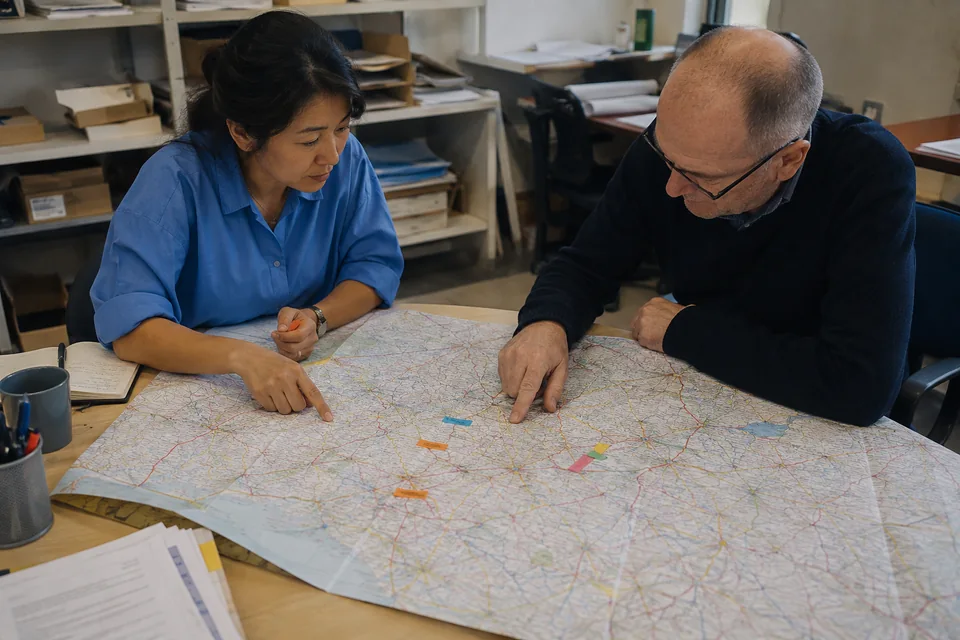
Two reps can each have a hundred customers and very different workloads. Visit frequency, distances, preparation time and the openings still to be made count for more than an equal split of the rows in a file.
Tell the territory apart from the route
Territory planning assigns a portfolio and a responsibility over a period. The sales route organises the journeys of a day or a week inside that portfolio. Optimising the order of the stops does not fix a territory that permanently contains more work than the rep can handle.
So start with the workload and the priorities, then check the geographical consistency. An administrative boundary is a convenient starting point, not an obligation. An account close to a rep’s home can be more accessible than others in their official département, the French administrative area.
Build a base that represents the field
- →An identified establishment: a visitable address, verified contact details, open or closed status, and no duplicate.
- →A service segment: the visit frequency and duration wanted, defined by what the account needs.
- →An activity status: customer on reorder, recent opening, prospect or account to reactivate.
- →Constraints: delivery windows, access time, fixed appointments and journeys that need an overnight stay.
The SIRET number identifies an establishment with fourteen digits, as Insee, the French national statistics office, explains (French). It helps to avoid treating several sites of the same company as a single address. The CRM’s internal numbers still have to be kept, to link orders and history.
Calculate hours, not just accounts
Over a given period, add up the number of visits planned multiplied by their duration, the estimated travel time, the preparation and the follow-up. Add a separate budget for prospecting and the unexpected. Use observed data where you have it; the assumptions must stay visible and open to revision.
| Monthly workload | Territory A, dense | Territory B, spread out |
|---|---|---|
| Visits planned | 60 × 45 min = 45 h | 48 × 45 min = 36 h |
| Preparation and follow-up | 60 × 15 min = 15 h | 48 × 15 min = 12 h |
| Estimated travel | 25 h | 45 h |
| Prospecting and contingency reserved | 15 h | 15 h |
| Total workload | 100 h | 108 h |
In this example, territory B plans fewer visits and yet requires eight hours more. If each rep really has 105 hours for these activities, B exceeds its capacity. Adding twelve visits to equalise the volumes would make things worse. Check capacity after internal meetings, leave and other duties, without counting those hours twice.
Do not confuse potential with workload
A territory with strong potential may require a temporary investment, particularly to open a new network. In that case, document the time spent winning it and the objective expected. A mature area that already produces revenue does not automatically justify more visits than accounts still being developed.
- Describe the needs
Accounts, frequencies, visit durations and journeys.
- Compare the capacity
The calendar available after leave, meetings and internal tasks.
- Test the boundaries
Build real days and look at the journeys that straddle two areas.
Two territories with the same number of customers can require very different workloads.
Test the boundaries with real days
Group the accounts into clusters that can be visited, then simulate several representative days: a dense day, an outlying area and an appointment at a fixed time. Road times are not enough. You have to include parking, walking and a margin between two appointments.
The guide to planning a sales route lets you check that schedule. An area that looks balanced on a map can produce two hours of empty travel at the start of every week. Chasing a perfect geographical boundary at the expense of when customers are willing to receive visits can also make those visits worse.
Prepare the handover
A new assignment needs an effective date. Orders in progress, open proposals and commitments made before that date must stay readable. Also decide who handles an old dispute and how commissions are attributed, in line with the applicable contracts.
Give the new owner the professional contacts, the delivery preferences, the last decision and the next actions. A simple list of addresses does not replace the visit report. For important customers, arrange a joint introduction where that helps continuity.
Revise the split on the basis of facts
After a complete period of operation, compare the estimated workload with the observed time by broad category. Look for accounts left uncovered for long stretches, avoidable mileage and visits that no longer answer a need. Also measure the commercial result, without automatically attributing to the split a change caused by a promotion or a stock-out.
The sales dashboard can show coverage by segment and the share of overdue actions. Revise the frequencies before systematically moving the boundaries. Some difficulties come from an unrealistic service level; they would follow the portfolio whoever owns it.

By Anatole Briant

By Anatole Briant

By Pierre Lerebours

CEO of Salesia
Anatole Briant is CEO of Salesia. He is your contact for demonstrations, pricing and partnerships.