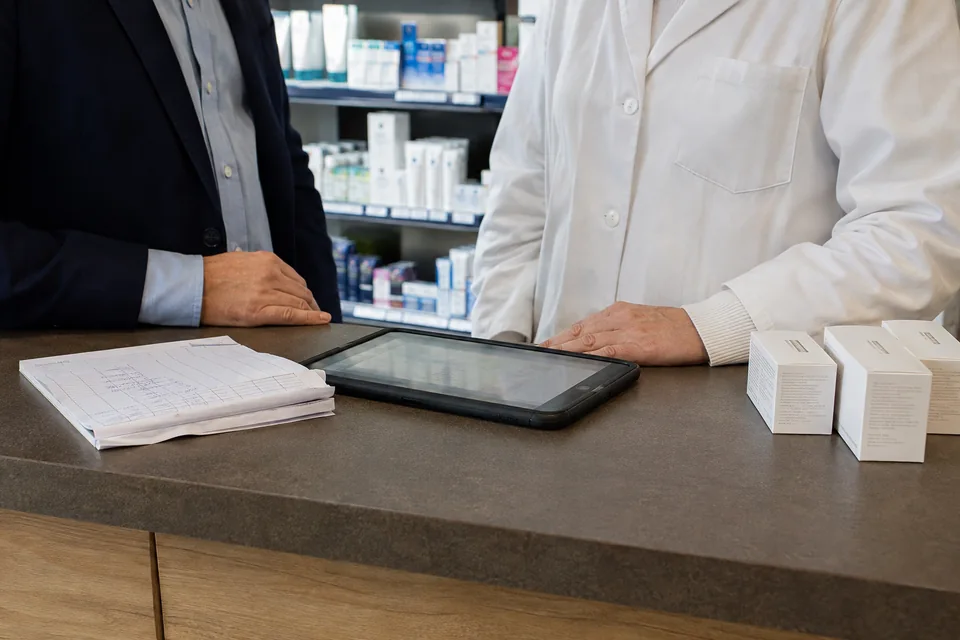
A digital purchase order is useful if the price agreed at the counter reaches the invoice and the parcel intact. Replacing a sheet of paper with a tablet is not enough: you have to rework the catalogue, the commercial rules and the transmission checks. Here is a worked case for preparing that switch and calculating what it is worth.
Start by following one order
Take a skincare brand with 18 products and 600 orders a month. Some arrive during visits, some by email and the rest through channels that are already structured. Over one week, the sales admin team times the active work: identifying the customer, keying the lines, checking the discounts, correcting and transmitting. Time spent waiting for a reply is measured separately.
In our example, 240 orders require re-keying. At 12 minutes each, that is 48 hours a month. The total volume of 600 orders must not be multiplied by that time: the 360 orders already handled another way do not offer the same saving.
Prepare the catalogue and the rules
For each product, gather the product code, the selling pack, the applicable price excl. VAT and the validity dates. A box, a single unit and a case of six have to be kept apart. Archive old product codes rather than reusing them for a new product: past orders have to stay understandable.
Then write the terms as cases you can check. For example: six units at the base price, twelve units with an agreed discount, two free units above a threshold. State whether the threshold counts per product or across the range, whether discounts stack and who can grant an exception.
Run a pilot with the difficult cases
Pick a few reps, someone from the sales admin team and a logistics contact. Put the same orders through the new workflow and through a reference calculation. Use test data so that nothing is shipped or invoiced twice.
- →Simple order: the right customer, two products, a delivery address different from the billing address.
- →Commercial order: a tier crossed, a free unit, a display unit added and an exception sent for approval.
- →Interrupted order: network lost after approval, the app closed, then reconnection. Only one order must be created.
- →Corrected order: a product unavailable, a quantity changed or a partial delivery. The customer, the sales admin team and the warehouse each have to see the right version.
Proof of transmission matters as much as the confirmation screen. Keep apart an order saved on the device, received by the server, accepted by the invoicing tool and passed on to logistics. A “Send” button proves none of the steps that follow.
- Saved
The order exists on the device.
- Received
The server confirms receipt.
- Accepted
The invoicing tool accepts the data.
- Transmitted
Logistics receives the expected lines.
Test reconnection and resumption: only one order must be created.
Calculate the gain without double counting
Suppose active processing falls from 12 to 4 minutes for the 240 orders concerned. That leaves 16 hours of checking a month; the time freed up is 32 hours. With an internal assumption of €30 per loaded hour, the capacity recovered is worth €960 a month.
With a hypothetical recurring cost of €400 a month and €2,000 of set-up spend, the monthly balance is €560. Payback is 2,000 ÷ 560, or about 3.6 months. These figures illustrate the method, not a Salesia price. If the balance is nil or negative, there is no positive payback period to announce.
Measure the errors that remain
An automated price can be wrong if it was configured badly. A correct product code can point to the wrong pack size. During the pilot, therefore, record corrected orders, duplicates, logistics returns and credit notes attributable to the order. Always state the sample size and the period.
Keep a fallback procedure: who picks up a blocked order, where the correction is recorded and how to stop a manual chase from creating a second shipment. At launch, one person should review the exceptions daily, even if most orders go through without intervention.
Decide on the roll-out
Extend the pilot once the reps can find an order, the sales admin team can explain every amount and logistics receives the right lines. Set the success threshold before the test: active time, correction rate and transmission delay. Then compare weeks with similar volume and complexity.
To write the specification beyond the mobile order form, read the guide to B2B order taking. It sets out how the different channels connect to invoicing and picking.
Test your own order workflow
Bring a few representative orders: we will show you how to check the catalogue, the terms and the transmission in Salesia.
Add to your tests the baskets that sit just either side of the free-shipping threshold and the minimum order, after discounts have been applied.

By Anatole Briant
By Anatole Briant
By Pierre Lerebours

COO of Salesia
Pierre Lerebours is COO of Salesia. He is your contact for implementation, training and ongoing support.